Saturday, July 25, 2015

Making increase with Mel Disselkoen's OTS, On The Spot Queen Rearing

 July 23 was the day to go back into the starts and check for new queens.  In May, I had one hundred percent success, queens in every start.  June 23 I dispatched all of the queens.  It took a lot of trust in the OTS system of queen rearing for me to leave every hive queenless, but I did.  From the nine hives I had, I increased to sixteen. I could have made more starts based on the brood I had, but chose not to.  On July 23, fifteen of those hives had newly mated OTS queens. These queens are also post solstice queens, mated after June 21.  I was able to break the brood cycle in each hive which in turn knocks back the mite population while the honeybee population  soars with a newly mated queen who won't shut down laying into the fall. Each hive will go into winter with younger, stronger bees.
I will give another week to the start that did not have a queen yet and check again.

Each start is building  up quickly and already needs a second deep box. I love to find the new OTS queens and see them draw out beautiful new comb! OTS queens that were raised by their own colony, mated naturally,  never touched by human hands, never shut down, never caged.  The bees do it all, the way they were created to.  I think that's why OTS is such a great success, it works with the bees and their natural behaviors. For more information on OTS, checkout Mel Disselkoen's website www.mdasplitter.com or his book, OTS Queen Rearing.

OTS Queen middle of picture. She had been near the brood, but scurried up to the honey near the top of the frame when we tried to get her on camera. Thanks to my bee buddy, Mary, for these great photos of my OTS queens.

Another OTS queen, just starting to lay. Look closely in the center of the cells and you can see the eggs she is laying.  It looks like a very tiny grain of rice.

Monday, July 13, 2015

A Swarm in July isn't Worth a Fly! HA!

Goodness gracious. Yesterday, I witnessed a swarm. Sad to say, it was my own. It was in one of my hives that I dispatched the queen in on June 23rd and had only notched one frame for queen cells.  I did not intend to split this hive, but wanted a post solstice queen. I had dutifully went back a week later and broke down all but 2 queen cells. I thought. I apparently missed some.
The queens should have emerged around July 9.  From what I can figure, the hive felt too congested and decided to leave with a virgin queen because with the timing she couldn't have been mated yet by July12. 
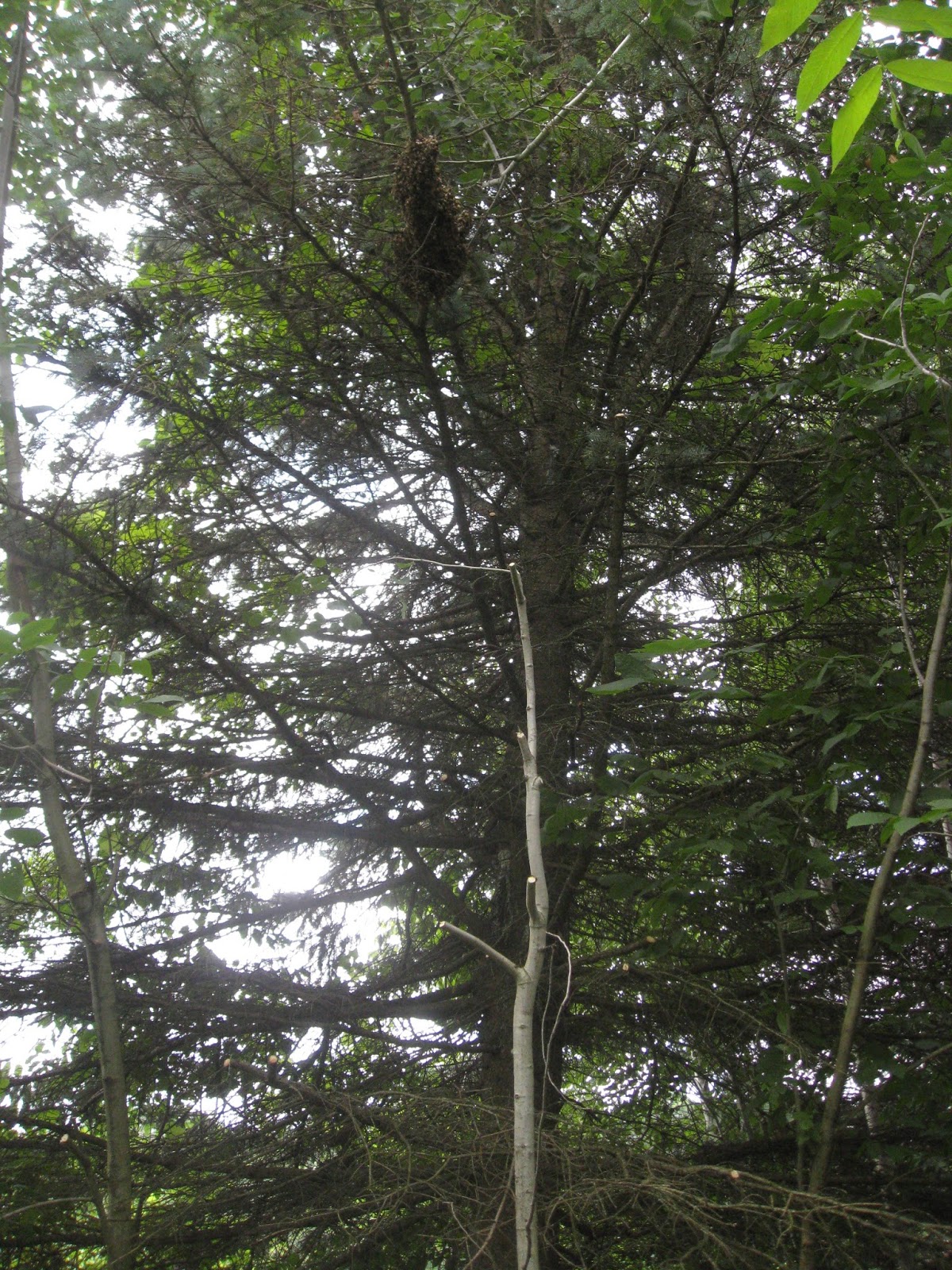
I was out weeding my flower beds on a lovely, sunny Sunday morning when I heard a loud roaring buzz?  I looked up and saw a cloud of bees in front of hive E.  More and more bees filled the air above my apiary and within fifteen minutes all settled on a dead pine tree branch at least 18 feet up in the air. I stood there watching the entire thing with my mouth hanging open. It was quite at sight to witness, I was mesmerized.
Once I realized, "Oh my word! My bees just swarmed!!"  I started to figure out how I was going to get them back. It took me about two hours to gather up what I needed and  lop all the dead branches below the swarm so I could get under them with a bucket.  Then our neighbor stopped by to chat. I thought it best not to mention the swarm of bees twenty feet away.  Once the neighbor backed out of the driveway, my husband and I commenced with our plan. He grabbed the long pole with bucket attached and I forged ahead with the tree branch lopper.  While walking to the tree our son pointed to the swarm and laughingly said, "You better hurry up, your bees are leaving."
I looked up  and sure enough, within moments they left the pine tree branch that only moments before they had been so attached to and in a large cloud flew up over our tree line, across the road, over the field and into the woods!!  Seriously!  I couldn't believe it.  I had just done all that work in preparation to retrieve them.  At least they waited until the neighbor left.
I had put a deep super of empty foundation on them 2 weeks ago, but they had not yet drawn that out. The 2nd hive body was full of capped honey and the bottom box with pollen, honey, a little capped brood and queen cells that had not yet emerged. There was still a decent amount of bees present even after the swarm. Today I took about seven frames of capped honey from that hive and extracted it.  That made me feel better about the whole bees leaving me thing. Still can't believe they swarmed!
See my bees betraying me upper mid to left in the dead old pine tree?  If you look close you can see where I lopped off a lot of other branches so that I could get underneath it with a bucket without anything obstructing me or the swarm.  Will never know if my plan would've succeeded as they flew off moments before I was able to retrieve them. The picture is only the top half of the pine tree, they were quite a ways up there!

There they are, all cozy, giggling at me. My first swarm. How touching! Honeybees, so unpredictable!

Tuesday, June 30, 2015

OTS Queens and dispatching

The last day of June has brought a second phase of new beginnings to my apiary.  I suppose I should say apiaries as I have two sites now.  The splits from the beginning of May have grown to five to 6 frames of brood and are ready to be split again.  Following Mel Disselkoen's method of rearing On The Spot queens to raise strong, young, healthy colonies,  one week ago I dispatched my queens in all the hives  and notched frames that had thirty-six hour larva.  Today I went back into the hives to find the queen cells where I notched  and make splits.  I did not make nearly the splits I could have.  I have to stop somewhere. One can only purchase so many hive bodies, frames, bottom boards and top covers in one season!  The main reason for dispatching the queens is to have a post solstice queen in each hive and for the break in the brood cycle which will decrease the varroa mite population.  See Mel Disselkoen's book, On The Spot Queen Rearing, or his website www.mdasplitter.com for more information.
 I will check for new queens in the starts 30 days from when I did the notching. That date will be July 23. 


OTS Queen,  Isn't she grand? If you can't see her, she is in the middle of the picture.
 
Queen in queen cage with attendant bees.  A beekeeping friend of mine had swarms given to her that were queenless.  I was able to give her two of my queens. That was of course after I made her catch the queens and cage them.
Expanding my territory. A friend who lives three miles from me  and lives on ten acres wanted bees on her property. I was more than happy to help her out!  She has beautiful gardens, woods and streams of water for the bees!
 
Selling my first Nuc. hive of honey bees! Wrapping up the nuc for a secure transport in the MDA Splitter box.   June 6, 2015.


Honey bee on milkweed. June 30, 2015. In field across from my house.

Milkweed.  See the milk? 

Honeybee on milkweed.

I never realized till tonight how beautiful milkweed flowers are and what a pleasing aroma they have.

Unidentified flower.  Close to my hives in the field. The honeybees and many other pollinators were enjoying it.


Friday, June 5, 2015

Multi Flora Rose

As I as standing and observing my hive entrances today,  a gentle breeze brought with it an aromatic delight.  What smelled so lovely?  I ventured beyond my hives to the field and found my delighted honeybees as well.  They were all over the many blooms of a Multi Flora Rose bush.  I looked up Multi Flora Rose and apparently they are non native and considered quite invasive.  Invasive or not, they smell delicious and the bees were enthralled with their blooms.
Multiple Honeybees on MultiFlora Rose bush

Honeybee on Multiflora Rose bloom

Honeybee with corbicula full of pollen on Multiflora Rose bloom.

Saturday, May 30, 2015

Sweet Success with OTS, On The Spot Queen Rearing

May 28, 2015- On The Spot (OTS) queen rearing is incredible!  Check out OTS Queen Rearing by Mel Disselkoen.  I was supposed to check the hives on May 29 for new laying queens in all my splits.  However, the weather was perfect May 28 and I couldn't wait one day longer.  I am pleased to say that each split had a laying queen, 2 of the splits already had some capped brood. The splits that stayed on the original site had almost all the frames drawn out and I had to place 2nd hive bodies on these! 
The artificial swarms with OTS queens from last year had packed out their hive body, had drawn out all the frames  of foundation and had multiple frames of capped brood.  I needed to place a second deep hive body on them also.  Because the artificial swarms were so strong, I shook some bees from those hives into a couple of my weaker starts ( starts where the queen had just started laying because I saw only eggs), to help them build up quicker.
I still have two starts to check next week on June 3. That hive had been notched 5 days later than the other hives.  If those two starts also have laying queens, that puts me at eleven hives going into summer, Yippee!  All of these from three overwintered hives, that had OTS queens started from just one hive one year ago.
That is more than 100% success!

I plan on moving most of my splits to a friend's twenty acres.  After the summer solstice, I will have to dispatch the queens and then decide if I want to continue to make more splits or have them focus on honey or a little of both.  That is the fun part of it, having so many options of which way to guide your bees.  Needless to say, either way I needed more bottom boards, top covers, hive bodies and frames etc.....  To save some cash, I bought unassembled frames and along with my husband put together 250 frames in the last 2 days!  A fellow beekeeper had made a jig that he let me borrow, it saved a ton of time as we could make ten at once and with the nail gun it went very quickly.

I also decided to try and catch some free bees.  I have two swarm boxes up, but no permanent residents yet. I have seen bees coming to check it out, maybe scouts, maybe just curious  bees. I put up a couple pictures below of the swarm boxes. I tried to stick to what Honeybees like and don't like based on the book, Honeybee Democracy by Tom Seeley. It is a very interesting read all about swarms.

Some of the hives on a "bee happy" kind of day

Some of the 250 frames we put together on this rainy May day.  The ones on the left don't have foundation yet. I use the black because it is easier to see the eggs and larva on and is recommended in Mel Disselkoen's book, OTS Queen Rearing.

Swarm box about 8 feet up on neighbor's fence post.  Inside are 2 frames of older brood comb and 3 frames foundation.  I also placed lemon grass essential oil on a paper towel and put it in a baggie with small opening. 

A few visitors to the box.  If they were scouts, the honeybees did not vote for my box.

My other swarm box approximately 10 feet up at a friends house a few miles away from me.

Sunday, May 10, 2015

May 9 Full Circle

It was a year ago, May 9, that I brought my first hive of bees home. I went into the fall with three hives and came out this spring with three. 100% overwintering success! This week I went back into the hives after notching frames last week and found queen cells. Those two hives were each split into 4 hives including the artificial swarm.  I currently have 3 hives with queens and 7 hives waiting to be checked at the end of May for new laying queens.  I have one more hive to split this week because it was notched later than the other two.
 2 Artificial swarms and 5 splits with queen cells

The 3 original hives. The tallest one in picture still needs to be split this week. The other 2 are splits with queen cells, queens should be emerging today.  Will check all the splits end of May for new laying On The Spot queens.

Honeybee on Grape Hyacinth in my yard.

Saturday, May 2, 2015

May 2 Dandelion Time and Splitting

I can't believe I have come full circle with my honeybees and  am now launching into my second year of beekeeping. This week the temperatures were over 60 degrees F. and it was sunny, decent weather to make my artificial swarms  and notch my brood frames per Mel Disselkoen's On The Spot (OTS) method.  His method can be found on the web  @ www.mdasplitter.com  and in his book, OTS Queen Rearing, A Survival Guide For Beekeepers Worldwide.            .
Two of my hives had over eight frames of brood.  They were strong enough to remove the queen with 2 frames of brood to make an artificial swarm and do the notching on the brood frames left at original hive. I was able to notch at least 4 frames in each and will now check back in a week for queen cells.  I will then be able to make splits using a frame with a queen cell on it and at least one other frame of brood.  In doing this I have prevented my hive from swarming and am able to make successful splits with strong healthy queens from my own backyard!
The other hive will have to build up a couple more frames of brood before I am able to remove that queen and notch the frames.
Dandelions  are blooming and many trees are popping also.  Great sources of nectar and pollen for the bees.
Honeybee on Dandelion


Check out all the pollen on her body, coming in for a landing on Dandelion bloom

Almost a full load, time to head back to the hive.