Tuesday, November 21, 2017

OTS Queen Rearing Wrap up for 2017 Season.


My last post was  in April! I can't believe it is now almost Thanksgiving.....the bees have kept me busy this year!! This past May and June are a blur, a literal fuzzy, buzzy, blurring of bees.  Bees at dawn, afternoon, dinner and dusk. Honey bees encompassing my thoughts from the moment I awoke to when I'd lay my exhausted head down on the pillow. When I drifted off to sleep, it was dreams of honeybees for me.  I may be exaggerating slightly, but honestly, there were numerous spring days when this was entirely true.

Winter left me with 17 hives out of 31.  Of these I needed to repay a dear friend 7 nucs with overwintered queens from the prior season.  Using Mel Disselkoens OTS method of making splits and queen rearing, the honeybees and I were able to fulfill our debt of 7 nucs, sell 15 nucs and keep 5 overwintered queens and a number of starts from the overwintered hives for myself. I let the May starts with daughter queens and the 2016 overwintered queens build up again until July and then split them again. I also hived six swarms.

  I am going into winter with 63 hives, the large majority of those being July starts with On The Spot Queens. Mating success this year averaged to be near ninety percent. The failures were due to virgin queens never returning resulting in working layers. I do not try to save working layer hives, I count them as a loss. I shake out the bees and give their combs and stores to other hives.

Thanks to the patience and time of another seasoned beekeeper, I also learned how to mark my queens this summer and began to learn how to graft. I got a taste of the process and steps of grafting but I am in no way able to graft larva well enough yet to raise quality queens with grafting. I will continue to increase my knowledge and skills in that area but for now I will continue to raise queens using OTS queen rearing.  To my knowledge, in the past four years of raising queens this way, I have never had an OTS queen rejected, killed or superseded. Once she comes back from her mating flight and starts to lay, I no longer worry.

I took many photos of honey bees and honey bee related activities over this past bee season. Below each I give some explanation.  I hope it will help explain how I keep bees and why I use the methods that I do. Some are just honey bees on flowers, my favorites :-) Sorry,  but the pictures are in no particular order.
Me, proudly showing off a beautiful brood frame from a 2017 OTS Queen. June,2017. Nucs ready for pick up in the background.

February 22, 2017. The Silver Maple at the end of our street bloomed! Honeybee on Silver Maple Bloom.

Myself holding a frame of "wall to wall" brood! Newly mated OTS 2017 Queen. June, 2017

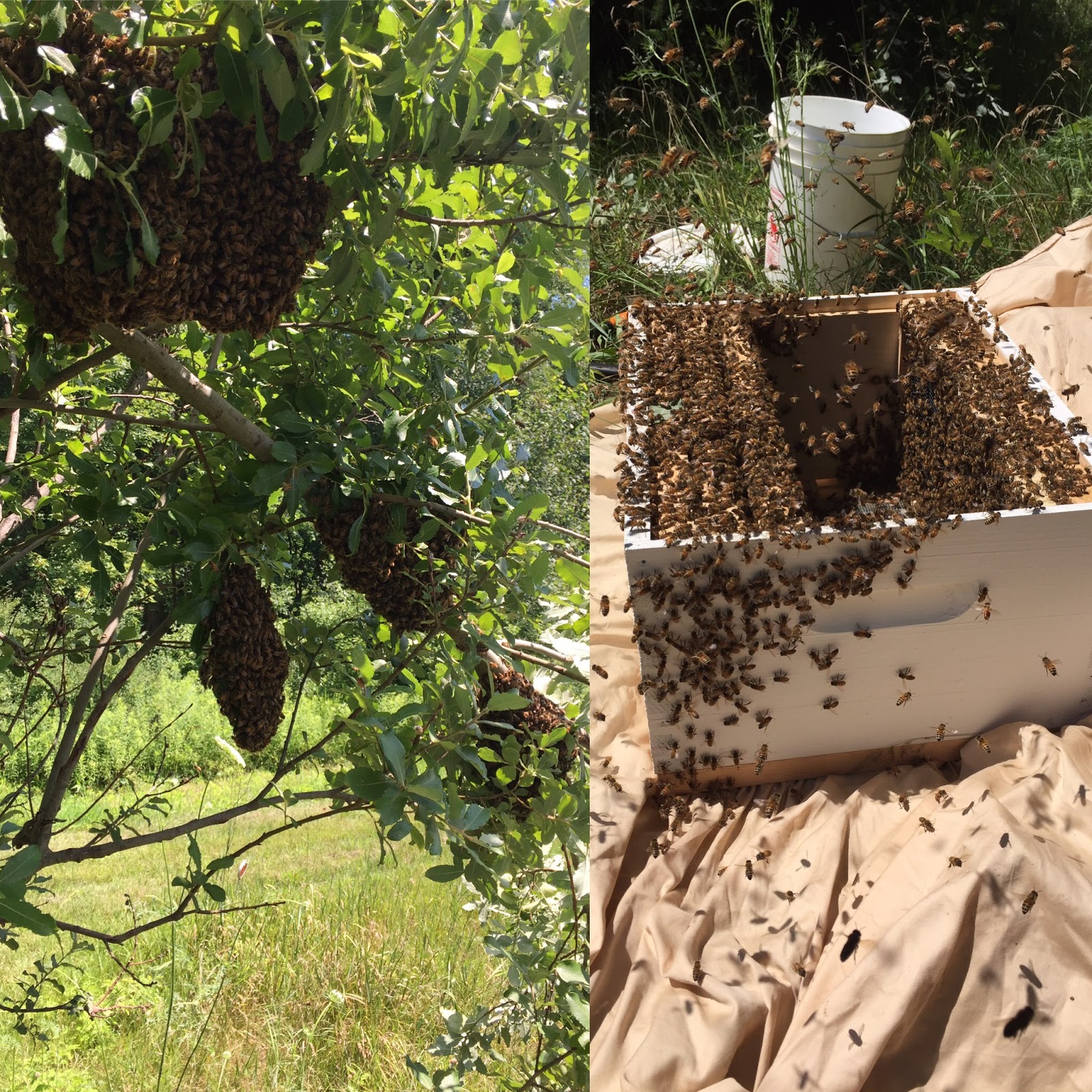
My "Barber" swarm. I was called by the Barber in Moline, MI to come and get this swarm. It was about 3 ft off the ground. This swarm came exactly one week after I had gotten a larger swarm on the exact same tree. Pheromones must have been lingering there.   

I mentioned I had experimented with grafting. I also did some work with some queen cells. Mentored under another long time beekeeper, I used baby nucs for mating these queens from cells and then introduced them using the method you see in picture above. I news papered the newly mated queen over top of the queenless hive.

One of my first swarms of the year up in a pine tree. Why do they love pine trees so much?!?

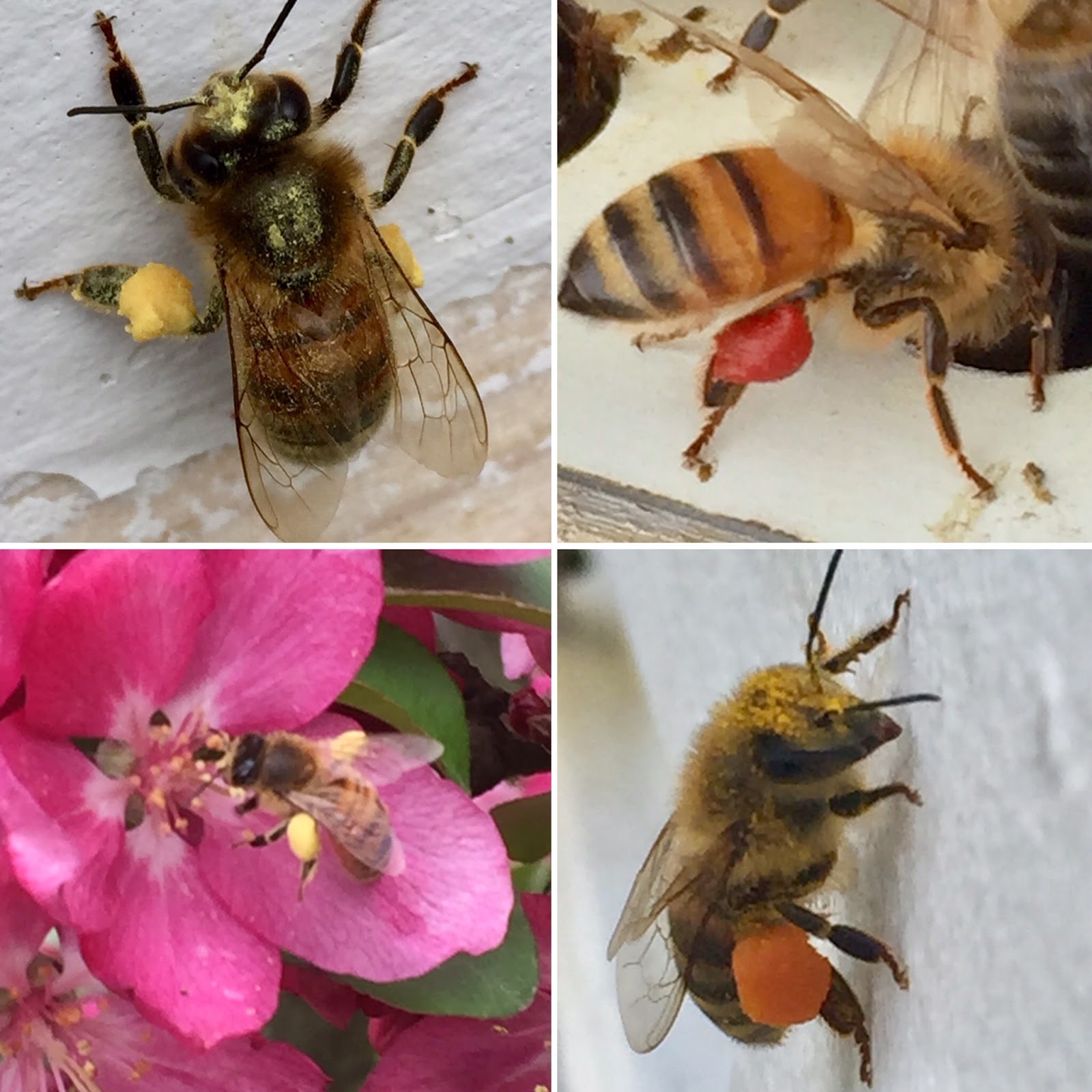
Oh Spring!!  I miss you already. Red pollen top right I've been told is from purple dead nettle.  Bottom left is honey bee on crab apple tree blossom in my yard. April/May 2017

Honey bee on Honey Suckle in my yard. Late May, 2017.

Aaaaah yes, amazing brood pattern!!! June 2, 2017. The solid work of an OTS Queen. Thanks Mel Disselkoen.

Middle of September, 2017. Time to top off all the July starts I made. I take no honey from splits I make in July.  I am happy if they fill a single deep prior to winter. I feed them sugar syrup the last two weeks of September. I use frame feeders that you can see in the bottom lower right of the picture. They hold one and a half gallons of feed. The bees can drain that in 3-4 days if they are healthy. 
First week of June, 2017. Nucs brought back to my home yard, waiting to be picked up and brought to their new homes buy their new beekeepers later in the evening. Selling nucs was fun and exciting but also sad.  I hated to part with those new queens and their beautiful brood..... but I realize I cannot keep them all even though I want to.  It was exciting to know my bees were going all over the state of Michigan and down into Indiana. A couple of them even made it to the upper peninsula!

Pollen traps. I tried the pollen traps this season. This is a picture of one on the front of the hive. This is a summer evening in early June and they are hanging out in it. The barrier/trap they have to go through to get in discouraged these foragers to head in that night. In 24 hours this hive brought in close to two cups of pollen!! It was amazing. I only left them on for a day or two. I felt guilty taking the pollen, silly I know. Maybe next year I'll play with pollen traps again.

Picture of the pollen in the bottom of the pollen trap. June 2017. Collected nearly two cups from this hive in 24 hours!!

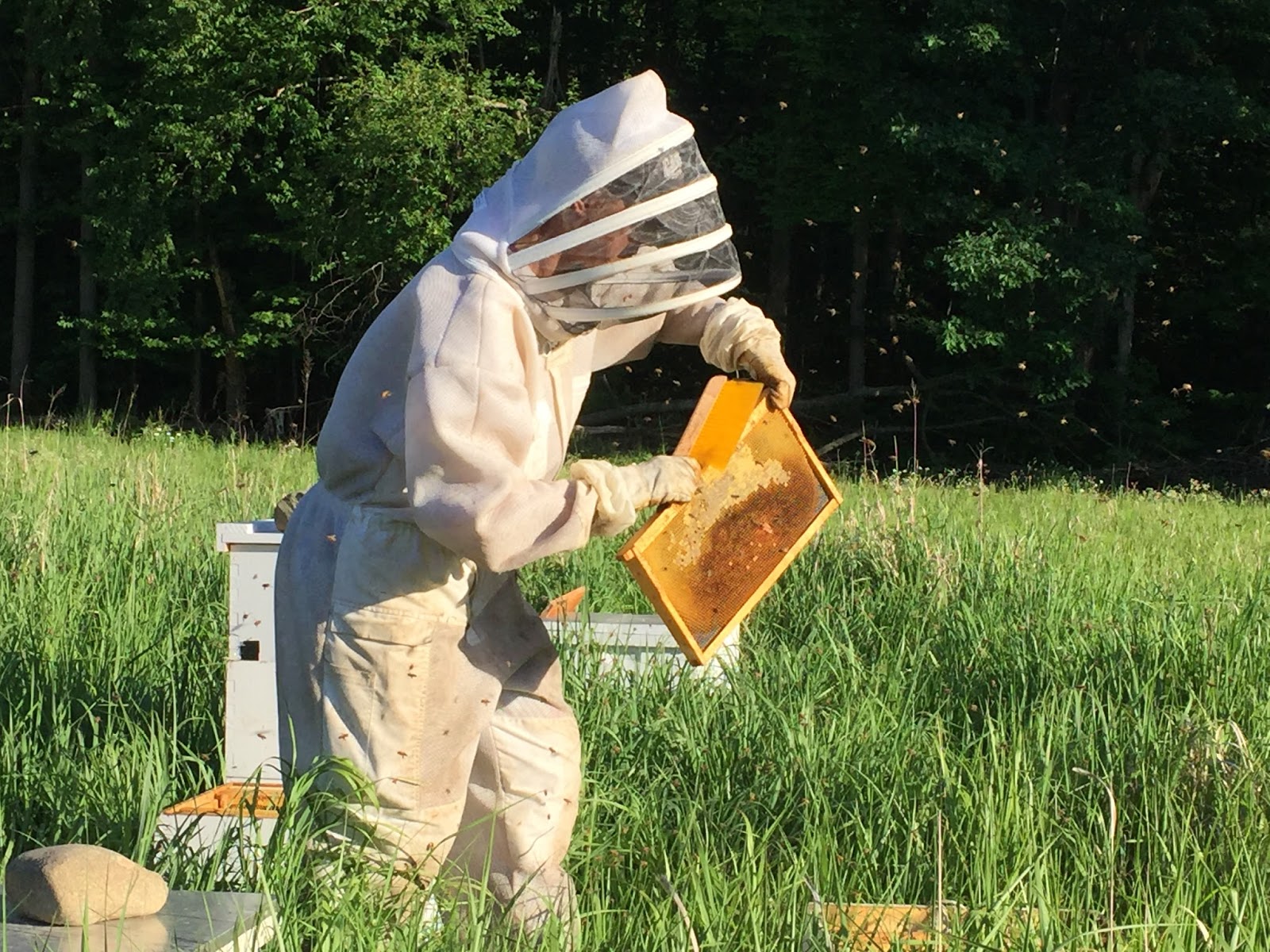
Me brushing bees off a frame from a laying worker hive. June, 2017

Me, with ever present hive tool in hand :-)

Newly mated queen, just marked. I did not mark this queen. My marks did not look near as nice as this. On one of the queens I marked, it looked more like a stripe all the way down her body. oops.   Need more time and practice marking :-)

Rainbow in one of my new yards. June 2017.

Honey bee on Sumac. This is the first year I've caught them on it. I didn't realize how many dainty little flowers were on Sumac and how beautiful they are! June, 2017. Dorr, MI.

Honey bee on Canadian Thistle. August, 2017. Bentheim, MI.

Honey bee alighting on Star Thistle, Dorr, MI. July, 2017.

Honey bee on Buckwheat Bloom, Dorr, MI. June, 2017.

Honey bee on Star Thistle, June, 2017. Dorr, MI.

Honey bees gathering nectar from Sumac, late June, 2017. Wayland, MI.


Honey bee on Loosestrife.  Dorr, MI.

July, 2017. POLLEN in frame!!

Field of bee balm, many pollinators enjoying this. Hopkins, MI. July 18, 2017.

Honey bee on bee balm. July 18, 2017. Hopkins, MI

Crazy weird swarm in four parts!  July 2016. Wayland, MI.

Honey bee on Canadian Thistle, July 14, 2017. Bentheim, MI.

September bloom, unidentified.

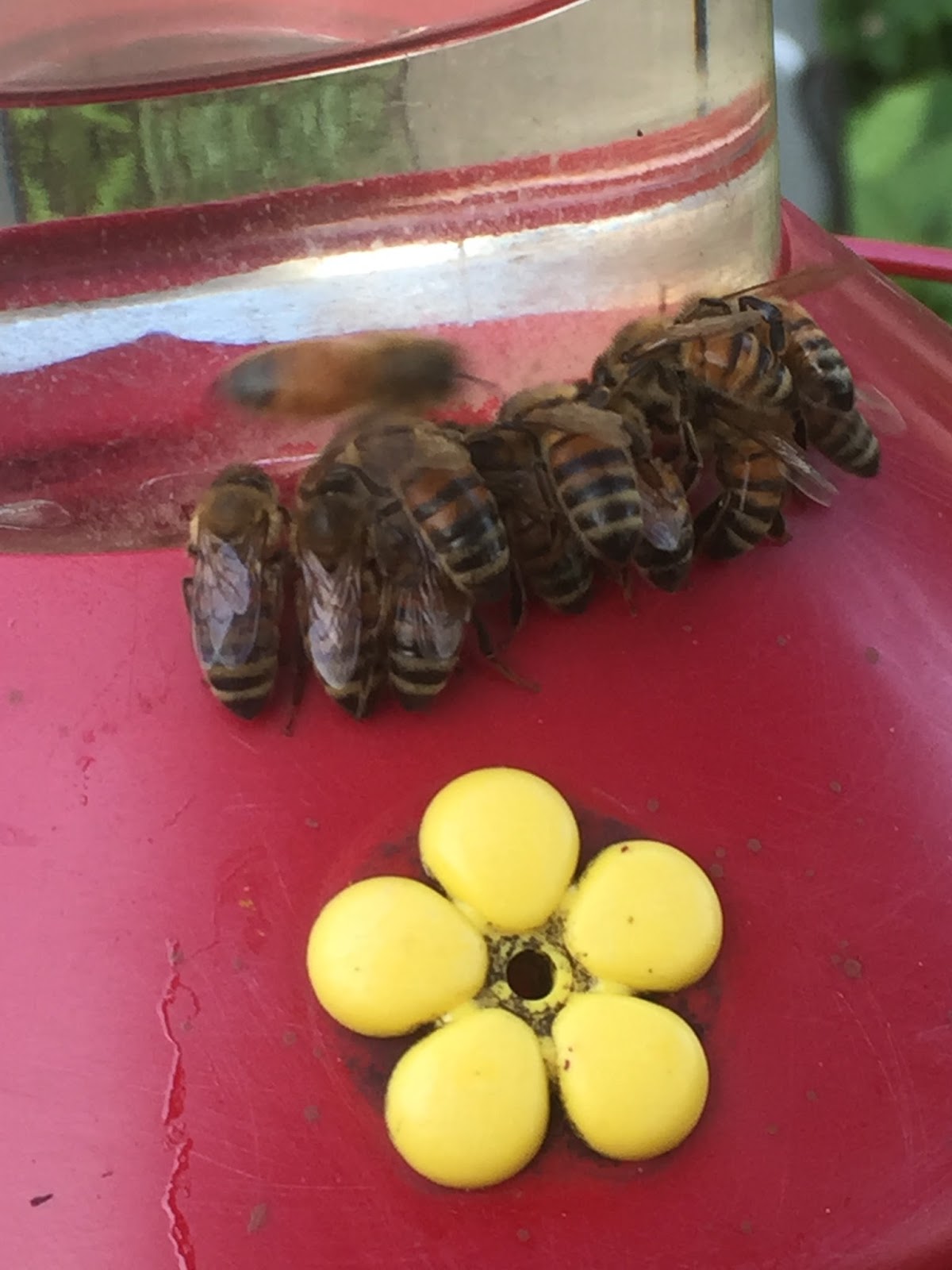
Naughty honey bees on my hummingbird feeder, October, 2017

Honey bees with  suspected goldenrod pollen, Sept, 2017.

New yard sheltered by pine trees in Hopkins, MI. These make for a wonderful wind break. Have fifteen hives there this winter. Hoping for the best!

Honey bee on Chicory, such a pretty blue. Rear view with creamy white colored pollen. August 12, 2017. Dorr, MI.

Honey bee on Golden Rod. Sept 2, 2017. Dorr, MI.

Honey bee on Golden Rod with pollen. Sept 2, 2017. Dorr, MI.

Crazy late swarm, Sept 2, 2017. So a late swarm is bad for many reasons. Why did it swarm so late?? Varroa mite infestation likely.  Should have done a mite count on these girls, but didn't. Shouldn't have kept them, but did. It is my little experiment. Because it was a good size swarm,  I hived them. Treated them with an oxalic dribble while they were still broodless  and fed them for 2 weeks. They were also given some empty drawn comb and a couple frames of honey. Within weeks they drew out 5-6 combs and the brood pattern was top notch. We'll see how they do through the winter. If they don't make it, they still drew out six frames of foundation for me.

The Sept 2 Swarm still hanging out in the tree before I hived them. The swarm is in top middle to right of the tree. See picture above for more info.

Yes that is all SUGAR! You would not imagine the questions and comments you get while waiting in line at Costco with all this sugar on your cart. When I respond that it is for Honey bees, you'd think I was a Super Hero!! People around me and the cashiers start thanking me and patting me on the back, telling me what great work I'm doing. So much so that I thought next time I just might ask for donations ;-) Love that the general public is so pumped up about Honey bees :-) My kids, on the other hand, vowed they'd never go to Costco on a sugar run with me again.

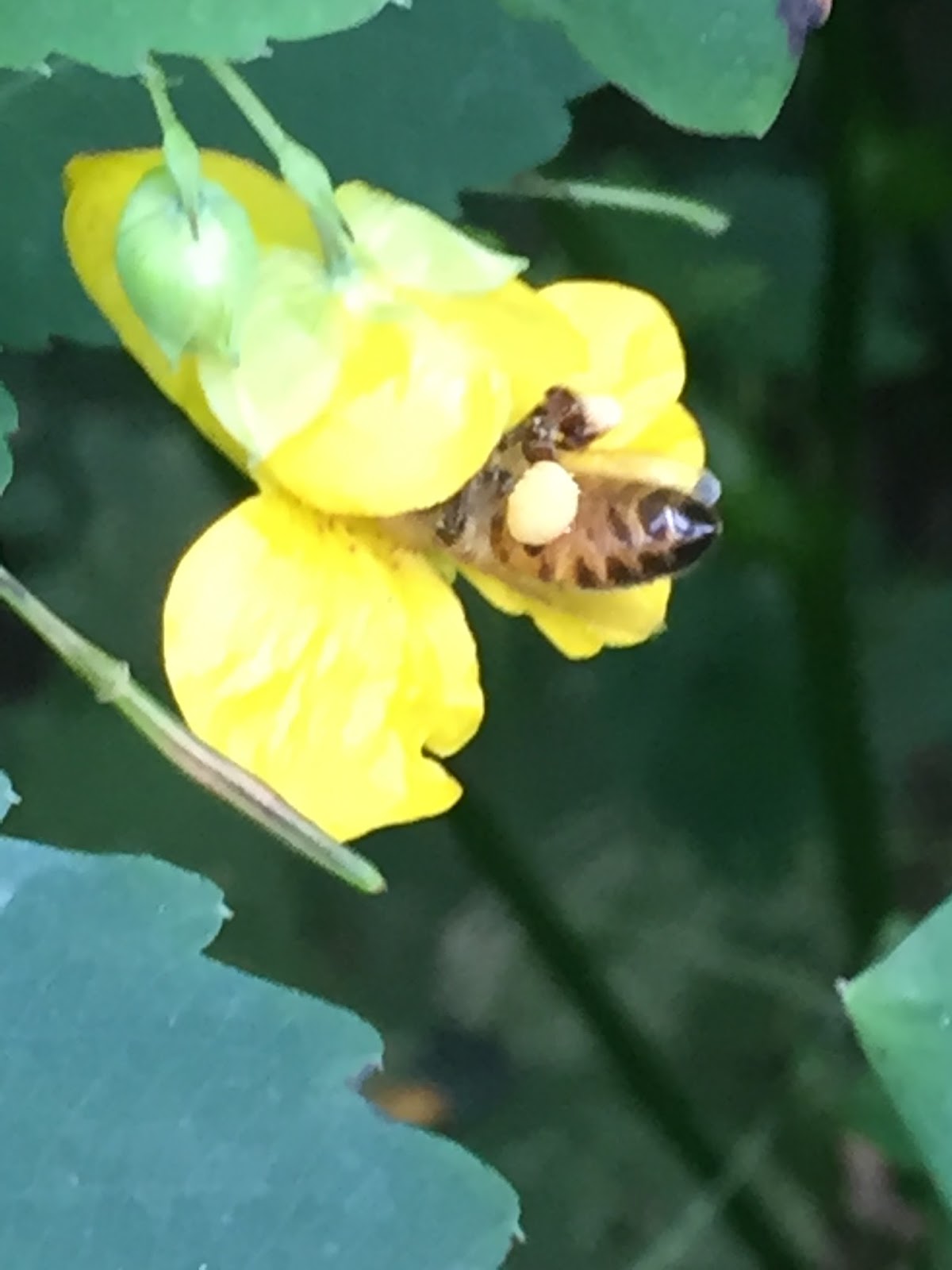
Honey bee on yellow Jewel Weed. September, 2017. Hopkins, MI. First time I had seen the yellow, I usually find the orange.

My faithful Dadant smoker! Pine needles and Sumac work for me!

Honey bee on Zinnia, I plant these from seed every year. Rows and rows of them. They bloom till frost. I've seen honey bees and bumbles still working them in October.

An Autumn favorite. Honey bee on Sedum. Dorr, MI. September, 2017.

Honey bee on Zinnia, July, 2017.

I broke open some honeycomb while breaking apart supers. Didn't take but seconds for these girls to take advantage and have some of their hard earned reward.

Honey bee on Milkweed. June 19, 2017. These smell lovely.

Older forager Honey bee on Milkweed bloom. See her frayed wings?? June, 2017

Going in. Honeybee on Jewel Weed. September, 2017,

Loaded down with pollen. Honey bee on Jewel Weed bloom. Sept, 2017.

Late June 2017 Swarm. Why can't they all be this simple? Four feet off the ground. One snip of the branch and into the box you go!


With all those starts, I needed more equipment!! Thanks Wayne for being supportive in letting me expand and helping me transport all these boxes and frames back home :-) July 3, 2017.

Honey stomach full. Little belly almost translucent with nectar!

Honey bee on Queen Annes Lace! I honestly did not think bees worked the Queen Annes, I was wrong. Not only Honey bees but other pollinators too. August 12, 2017.

Love, love, love new wax with snow white cappings over freshly cured nectar!! July, 2017.

 I had a swarm for every month this season. This is the August 8 swarm.

Honey bee on Joe Pye Weed, August 12, 2017. Dorr, MI.

Honey bees on Rose a Sharon bloom. August, 2017

Late summer forage of Iron Weed, and Queen Anne's Lace.
Sept 25, Dorr, MI. Honey bee on Aster.

Honey bee on type of mint bloom, August 13, 2017.

The crazy four part swarm hived. July 16, 2017. I found a sheet to be extremely valuable this year when hiving swarms.

Honey bee on white Joe Pye Weed.


Honeybee on Alfalfa bloom, Sept. 15, 2017. I have hives on the edge of a farmers hay field. I was so please when he said he lets the alfalfa bloom before cutting.  I know honey bees are not the most efficient at pollinating alfalfa but nice to know if there wasn't other forage available in September that acres of this was right outside the front step of their hives

Sunday, April 30, 2017

Pollinators, Pollen, Protein and Productivity!

It is April 30  and the brown, drab, lifeless landscape of late winter and early spring has transformed into a breathtaking wonder! Trees adorned in white, pink and purple demand to be noticed. The countless shades of green, the plants that grow inches overnight, the smell of lilacs, and the melodious buzzing of the bees never cease to amaze me.
The overwintered colony whose cluster was only 3 to 4 frames months ago is now bursting at the seems of its two deep hive bodies. I dare say, swarming is close at hand. I have started the OTS, On The Spot queen rearing system by removing the queens from some of my larger hives and making an artificial swarm with each.  This ensures, they can't swarm on me.  I notched the remaining brood frames in each hive and will check 7 to 10 days later for queen cells and then make splits.  I hope to get pictures of this process for the next blog.  For now, enjoy these pictures.
This forager is bringing back red pollen. I've been told it is from the purple dead nettle, picture below.

Purple Dead Nettle, suspected source of the red pollen pictured above.

Hives near the Purple Dead Nettle.  However I couldn't find a honeybee on these a the time.

Honeybee on Willow.

Bumblebee on Maple bloom

Native bee on crab apple blossom

Honeybee on crab apple blossom

Honeybee coming in for a landing on crab apple blossom

Honeybee forager with large load of pollen, crab apple blossom.

Bumblebee on Bleeding Heart bloom.

Bumblebee on Quince bloom.

Honeybee on unknown flower

Honeybees on freshly drawn comb.  Forgot to put the queen excluder on this hive and they built this above the frames.

New wax with eggs laid in each cell. Honeybees tending to larva.

Saturday, April 1, 2017

Moving and relocating Honeybees in Michigan

"Out of sight out of mind" is a saying that many old time beekeepers repeat.  They know and have had the displeasure of moving colonies due to complaints about their bees. If no one can see your hives, the less likely they are to complain or request them to be moved.
The twelve hives I had to move today were not out of sight.  Their new locations will be.  I wanted to get the bees moved and settled in their new home before I pull the overwintered queens which happens in late April.
This time of year, one can't just pack up the hive and move it whenever one feels like it.  The temperatures really need to be above fifty degrees. If it's too cold, the bees are in cluster.  If bees are knocked off the cluster during the move and it is too cold for them to get back in cluster, the brood and or bees could be chilled.  After keeping them alive through a Michigan winter, I really don't want to off them in a move.  In Michigan, the weather is a pain in the butt!!  I needed at least two days over fifty with no rain.  Watching the forecast, I decided this weekend might work. Today was fifty-five and tomorrow should be over sixty.
This morning's temp was only thirty-three degrees, brrrr!  I went out in the morning and closed off all their entrances with hardware cloth (#8) and my husband secured each hive tight with metal banding.   By the time noon rolled around, it had hit fifty.  We loaded them up with a two wheel dolly on to the trailer.
Once we arrived at their temporary hold over spot five miles away, I opened up the entrances.  They were ready to be OUT!  After they have oriented there, I will move them back here and place them in their new locations. Hopefully, that will be tomorrow evening.
These bees escaped the screen somehow, a few more staples needed!

Honeybees not pleased to be caged in before the move.

The two wheel dolly was very helpful, needs some modifications though.  Larger tires and a longer base would be great.

All loaded in the trailer, now need to be secured.

Thanks Wayne for making sure we are all secure with tie down straps :-)

At temporary location 5 miles away.  Honeybees very eager to fly after being confined for a few hours.

Honeybees reorientating to their new location. Will stay on trailer until final move days from now.

Monday, March 13, 2017

March in Michigan-A Month of Extremes for Honeybees

We are now almost half way through March. Dreams and hopes of a gradual, even tempered spring warm up have been dashed by falling snow.  I awoke this morning  at 0530 to what I hoped was the bright reflection of the moon across the landscape.  I squinted my eyes and looked closer.  Nope, no reflection of the moon, just two inches of white snow. Just a week ago my bees had been buzzing in and out of my crocuses, gathering pollen.  Now their bottom entrances are covered with snow and no smart honeybee would even peep her head out of the small top entrance. The same top entrance that just days ago they were flying through with pollen loads on their hind legs. 
Temperatures have fallen into the teens the last few nights with day time temps in the mid-twenties.  Nothing to do now, but wait.  Wait for a day above freezing to check their food stores again.
So much for an early spring. Snow fall overnight, March 13, 2017.
March 7, 2017. Honeybees on Crocus

Rearview, honeybee on Crocus. March 7, 2017

Working hard on a windy day to gather some pollen. Honeybee on Crocus, March 7, 2017.

An older type of Crocus protects the bees from the wind while they are down in the flower. Honeybees in Crocus, March 7, 2017.

Honeybees in Crocus bloom, March 7, 2017. West MI.


Thursday, February 23, 2017

Honeybees bringing in pollen in February in Michigan!

Record temperatures in West Michigan this week have honeybees bringing in pollen like it was a summer morning! With temps hovering in the sixties and then breaking seventy with sunshine yesterday, the Silver Maples could not hold back.  They burst forth in bloom.  Skunk cabbage and Willow may also be blooming.  The bees were bringing in a variety of pollen until sunset.  Pollen means brood rearing and the bees will have to keep that brood warm.  More brood puts a higher demand on the colony. A demand I hope they can keep up with in the coming months.  A true Michigander knows we have not seen the last of snow even if he/she won't admit it. Hang in there Honeybees! I am checking my colonies regularly to make sure they have enough stores. If they are low, I am replacing with sugar bricks or frames of honey I saved from last fall.
Silver Maple bloom, February 22, 2017. Honeybees working these flowers, too high up for me to get a good shot of them.

Incoming with pollen loads, February 22, 2017.

Lost loads of pollen I gathered from "front porch" where the bees land. February 22, 2017. West Michigan. The yellow pollen may be Skunk Cabbage or willow. Tan to grayish green may be Silver Maple.

Unbelievable! First Crocus bloom on February 22, 2017.

INCOMING!! Twas like a summer day!! Silver Maple flow I guess :-) February 22, 2017.


Having trouble with pollen load staying in corbicula "pollen basket" I opened up entrance more after seeing what they were losing while flying in.  February 22, 2017, West MI.

Sweet Honeybee landed on my finger.  This was actually taken February 17, 2017.  I don't believe this was true pollen. We live near a lot of farms and the bees will gather what they can from animal feed and bird feeders if no real pollen is available.

Saturday, January 7, 2017

Spying on Honeybees during a Michigan Winter.

My husband has tools, lots and lots of tools.  The Snap On tool guy loves my husband.  I never really took an interest in the tools until my husband told me that he owned a Bore Scope, a long flexible tube with a small lighted camera on the end.  He says to me, "Ya know you could stick that in the top-hole of your hives and look at your bees."  Of course I could.  He also recently brought home, on loan for a jar of honey, a thermal imager.  I played with the thermal imager first.  Because of the wraps on my hives it is harder to see where the cluster is, however it would show heat coming from the top entrance hole.  Heat from a live cluster of honeybees.  I tried it on a friends hives who had no wrap on his hives and it was much easier to identify where the cluster was.  The thermal imager was exciting, but the Bore Scope was thrilling.  Thrilling enough to get me out poking it through the top entrance holes of my hives in nine degree weather with a windchill below zero.  Gotta love Michigan! 
Between the imager and the Bore Scope, I think I can confidently say with ninety-five percent certainty that a large majority of my hives are alive!!  That is much better than last year at this time, they had all met their demise except for two sick stragglers who died a couple months later.  I took a couple of pictures of the screen of the Bore Scope, I took video too of the bees but have not yet figured out how to get them to play on this blog!  The Scope was very helpful to see which hives had enough sugar brick and who could use some more very soon. You could get it down in between frames and see how much honey was left on the sides of the cluster.  A couple hives that I thought were down in the bottom box had moved up to the top box.  All useful information this time of year.  If we get a little warmer weather soon, I will be able to give bricks to those who need it without popping tops of those who have enough yet.  Saves me time and energy.  Energy I need to get through this Michigan winter!
Honeybees on top of their sugar brick inside the hive. Viewed on the screen while end of bore scope is in the hive.

Honeybees in Michigan winter staying cozy in their hive.  Seen through the tiny bore scope camera stuck in through the top entrance hole of the hive.

Baby it's cold outside!!! Nine degrees, below zero wind chill. Nine out of eleven hives in this yard alive :-)

Bore Scope came in handy to peek inside the hive without having to disturb them or pop covers off.  Able to check food stores and where the honeybees are at.

Sunday, December 11, 2016

Michigan Overwintering Honeybees

It is December 11, and Old Man Winter has finally hit West Michigan. My hive tops are laden with 8 inches of snow cover.   As I stand basking in the warm light and heat of my kitchen baking cookies, I look out at the hives adorned in their black cloak of tar paper and I smile. The thought of them all clustered together to maintain life and keep their queen at a balmy 90 degrees is nothing short of miraculous.  God, our and the honeybees creator, is to be praised!!  Such detail, intricacy and wisdom!!  To walk out into a snow filled apiary and place your ear up against the cold hive box and hear the low hum of bees vibrating their wings muscles collaboratively to maintain heat and life is amazing!!  I took a few winter pics of some of my hives and a fellow beekeepers. Enjoy.
Quickly peeked in on this cluster Dec 4, 2016.

Honeybees on sugar brick. December, 2016


December 11, 2016.  Yes, hundreds of thousands of Honeybees alive in those boxes! I can hardly stand to be outside in the whipping wind and snow.  The Honeybees are clustered down, maintaining the required temperature for survival and consuming the honey they had stored over the summer.  These hives have a barn for a wonderful  windbreak.

The snow actually helps insulate, but you need to make sure you have ventilation, somewhere for that warm air rising from the cluster to go so it doesn't condense on the underside of top cover and drip back down on the bees.  Honeybees can do cold, they can't do WET!

Can't get enough of awesome apiaries! Just to know there is life in those boxes in the dead of winter gives me hope for spring!