Thursday, June 9, 2016

Honeybee Swarm on a Chilly June Morning.

The morning started out like any other work day. I got up at 0500, went to the pool, swam 30 laps  and then headed the short distance to work.  I pulled in the drive of the parking lot at work.  It was 45 degrees, quite chilly for a June morning, but the sun was shining. As I turned towards the parking lot, I noticed a patch of brown in a small tree on the landscape.  I wonder if I am scanning subconsciously  for swarms all of the time??  I pulled off onto the grass and walked a few feet to the tree. It is now 0650 and my eyes behold a small oscillating mass of golden, sparkling ( the morning sun was shining directly upon them) honeybees!  It was a swarm!  Not just any swarm, a swarm within reach. All I needed to do was lop off one small branch and place them in my box.  I watched in amazement as one or two scouts broke off the small shining mass and flew off in search of a new home.
As I stood there gaping, my co worker pulled up, rolled down her window, and questioned, "What ya doing?"  I pointed and said, "Honeybees!"  She, knowing I'd not be able to focus on anything but the bees, said, "Are you gonna get them? You should run home and get your stuff, we'll be alright here till you get back."  I issued one, "Are you sure?" She replied, "Yes!"  Thanks Nikki!  That was the only encouragement I needed.
My bee buddy Mary came to be the branch cutter and be the courier to transport this sweet little swarm back to my place.  She also ended up being the photographer, thanks Mary!

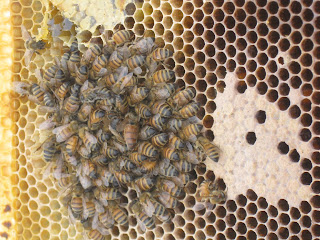
The tightly clustered swarm (remember it is 45 degrees!) just about to go into my nuc box. I had already placed some frames of empty comb and honey in there for them. June 8, 0720 AM!

Now how easy was that!  One small branch within easy reach! Wish all swarms were so simple. I transferred these girls into their new hive body later that evening. Found the queen and the bees filled out the five frames nicely.  It will be fun now to watch her start laying and build up brood. 

Booming Brood and Blossoms!

The nucs I have that have 2015 post soltice queens are building up nicely! Some of them have seven to eight frames of brood already with new bees emerging all the time. Around 4:30 on sunny afternoons they seem to have their orientation flights.  They have also been on the Dutch clover, Buckeye tree, Catmint, Dogwood and the Black Locust has just started to bloom here in West Michigan. I have yet to get a picture of them on the Black Locust bloom.
Honeybee alighting on Red Buckeye bloom. May 2016

Red Buckeye Bloom


Honeybee coming on for a landing on Dogwood bloom, May, 2016. I had watched my Dogwood tree bloom and did not see honeybees on it until the  white petals started to brown and then they were all over it for a few days. The flowers within the big white petals had popped open and they were gathering pollen and possibly nectar from the green little mass of flowers you see in the middle.


The honeybees love this Catmint perennial. I love it too as it starts blooming in May, splits well, does well in poor soil and does well with minimal water. Requirements for most plants in my yard!

Honeybee on Dutch Clover.  June, 2016. 

Honeybee on Dutch Clover, early June, 2016.

Honeybee on the Catmint blooms.  Hummingbirds and other pollinators love this also.

Honeybee orientations flights on a warm sunny June afternoon.

Honeybees, don't they just make you want to smile.

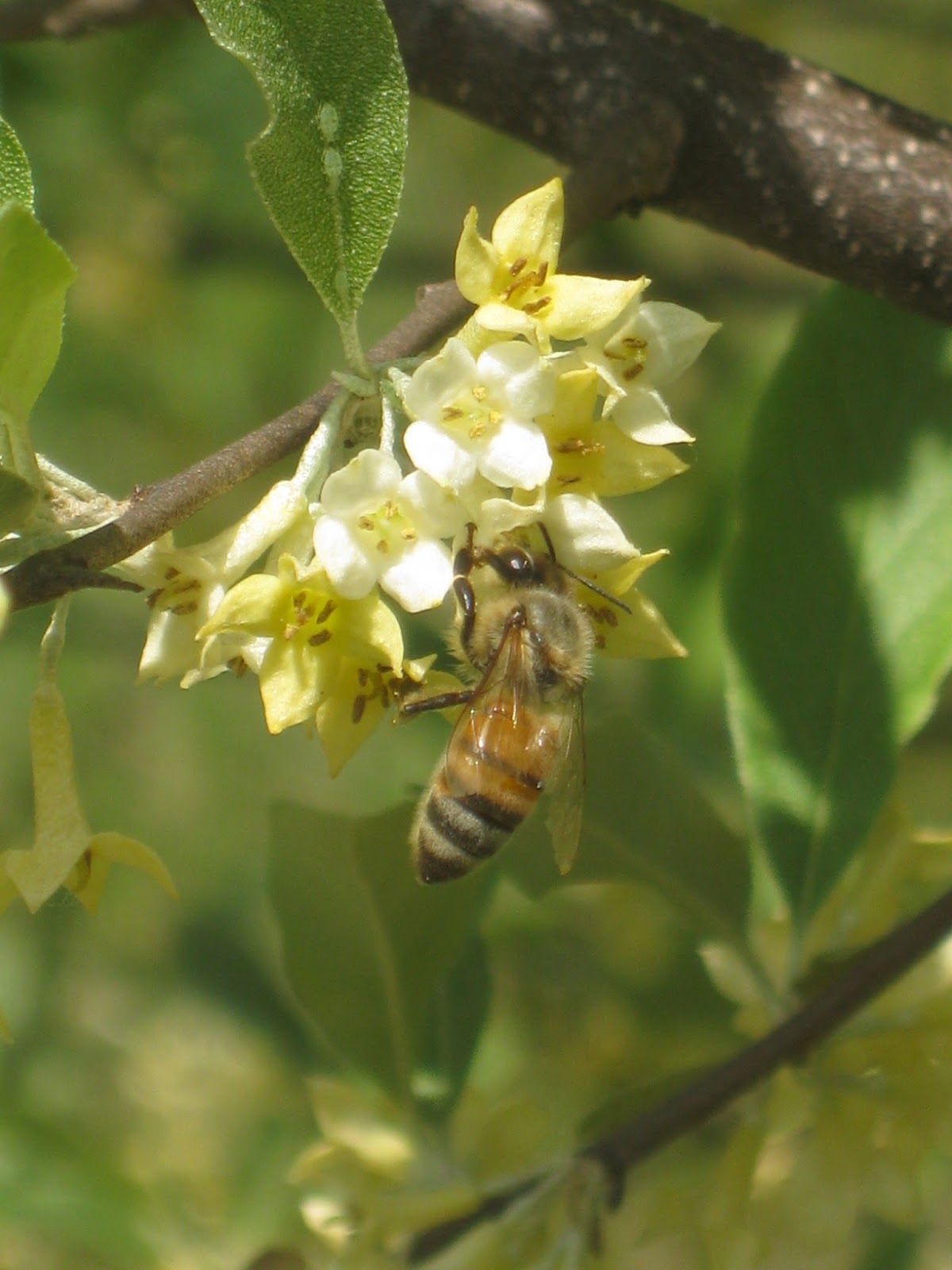
Honeybee on Autumn Olive Bloom, a species on the "Invasive list."


Honey bee on Autumn Olive Bloom, May 24, 2016.


Honeybee gathering nectar from Autumn Olive. May, 2016.

I couldn't resist putting this pose in here, Honeybee on Autumn Olive bloom. May, 2016.

Honeybee on Autumn Olive. May 2016. These flowers give off a heavenly aroma in the spring!


Friday, May 6, 2016

Honeybees and Trees. May 6, 2016

Last night I was able to bring home four more nucs and get them settled in.  Thank goodness for a few days of warmer temperatures and sunshine!  As if just for the honeybees arrival,  my Crab Apple tree and Red Bud welcomed the bees with blooms bursting forth everywhere today.  You could stand under or near the Crab Apple and hear their soothing buzzing and observe them gathering pollen and bringing it back to the hive.   The honeybees definitely preferred the Crab Apple over the Red Bud. There were only one or two honeybees on the Red Bud, but there were many native bees and bumblebees on the blooms.  I have no idea what the proper names are of any of the native bees or bumblebees, I will work on that!
Before keeping bees, I did not realize the importance of trees to the bees!  I have only begun scratching the surface of all the different types of trees, their bloom times and their nectar and pollen production for the bees.
If you want to plant trees for bees, contact Honeytree Nursery in Shelbyville, MI at honeytreenursery.com or email honeytreenursery@yahoo.com.  They are the experts in what trees you should plant for bees.
Honeybee on my Crab Apple tree

Crab Apple tree in full bloom, May 6, a welcome present to the Nucs I brought home last evening.

Honeybee on Crab Apple bloom.

My nucs, six now. First morning in their new home, settling in.

White Crab Apple I think??  The honeybees were all over these millions of blooms, but were too high up for me to get a good picture of one.  Way, way, way more blooms than a small planting of flowers could ever provide. Plant trees for bees!

An closer shot of the bloom from the tree above.

The only honeybee I saw on my Red Bud trees.

A native bee, unsure of the name, many of these were on the Red Bud

Big ole Bumble, I don't know the type, there were three of them on this Red Bud, often fighting with each other.


New Bee-ginnings, Michigan Honeybee Nucs, May 2, 2016

       It has been a while since my last post due to the fact there wasn't much to say as the remaining two hives I had in February, were both dead in March.  I found the queens in each and one even had eggs,  open larva, and capped brood.  They were giving it all they could, but there were too few bees to maintain the warmth they needed.
      Of course, I must begin again.  I knew I wanted nucs that had overwintered in MI.  Thanks to a wonderful  network of other beekeepers I was able to find MI bees that had successfully made it through the winter. These nucs have queens that were mated last July so I was able to receive them sooner than most MI nucs are available.  I brought the first two home last night.  I set them on top of the hive box that they will be going into and opened their entrances, giving them a chance to fly and orient to their new spot before installing them into the hive boxes. I can't wait to give them my extracted honey frames for them to lick clean and full frames of honey!

Incoming bees, the stick is there holding the entrance open on the nuc box. I set the nuc box on top of the hive box they will be going into, allowing them to orientate to their new spot.

Two nucs with bees adjusting to their new location.  After a day or so I will transfer the frames into the hive bodies.

Honeybees at entrance of the nuc.  The stick is there to prop up the opening. 

Red Bud starting to bloom. Other beekeepers have told me the bees do work the Red Bud.

NOT a honeybee, a native bee on the Red Bud bloom. I am not sure of the bees proper name.


Friday, February 19, 2016

Still Alive! 60 degrees F. on February 19, 2016

West Michigan is known for its erratic weather, today is a good example. It is 60 degrees Fahrenheit in February.  My honeybees are out taking their cleansing flights.  Cleansing flight meaning they've been "holding it" until they can come out and defecate or you know, poop. Honeybees are hygienic.  They like cleanliness and order. Because of this they will not do their duty in the hive unless they are under severe stress. They wait and wait and wait until a day like today presents itself and then out they go.
Honeybee poop! The little spots on the top cover are from the bees. If you are out there when they are whatever you're wearing will also be spotted.  

My remaining live hive at my place surrounded by empty hives that didn't make it. I figures they'd at least make a good windbreak till spring.  I have one other hive at a friends place that is still alive also. 

Monday, February 1, 2016

Honeybee cleansing flights

Happy February!  Today is February 1st, 2016 and it is near 40 degrees F. with sunshine this afternoon in West Michigan. A winter day that would strongly beckon any beekeeper to take a stroll out to their hives in search of signs of life.  Are the bees out? Are the dead being brought out? Is the snow around the hives spotted with orange and yellow?  If so, a smile spreads across the beekeepers face. So was the case with me today.  My two remaining hives are still alive and for this I am very thankful.  I try not to get too excited though as we have many a cold night until we see pollen or nectar available.  Last year my bees were bringing in pollen on March 31st.
Honeybees on a sunny winter afternoon in February returning to their top entrance hole after taking a cleansing flight.

This girl is soaking up the sun on the front of the hive. February 1, 2016. 40 degrees F.

Thursday, January 14, 2016

Michigan Honeybee Colony Loss

My "bee"ginners luck has come to an end. I knew I would have losses eventually, especially with my increased number of colonies going into winter. I did not realize how severe the loss would be.
I have gone from fifteen to two colonies in a matter of weeks. Three were gone before December. The other ten, according to notes all met their demise over the last week of December and first week of January.
I noticed one by one that no dead bees were being brought out to the landing board of the hive. I became more suspicious when I scraped out dead bees to keep lower entrances clear and neither heard or saw activity. On a warmer (above 30 degrees) day, I opened them up. In almost all the colonies I found a handful of bees on the comb with their queen right there in the middle of them, just frozen in time. Capped honey was on the frame and the deep super above them was full of capped honey.
What happened??? I don't have answers, I have theories. Theories that only lead to more questions.

I have helped other beekeepers in the spring with their dead out hives  and there were LOTS of dead bees to clean up, piled on the bottom board and stuck into the combs. My hives did not look like this. Most had a handful of bees with their queen on the center bottom combs and a scattering of dead bees on the bottom board. For as strong as these colonies were in September, I am surprised to find so few bees.  This is an odd finding.

I have had other beekeepers suggest that varroa mites "took over" in the fall and the majority of the bees just left. Maybe..... I did do brood breaks during the month of July to knock back the varroa naturally.  I did not do a mite count in the fall. I wish now that I would have. That would have been (if counts were below threshold) one more piece of evidence to "prove" it was not Varroa. I have learned one thing throughout all this, I will do mite counts from now on.

Another theory is pesticide exposure. We had an extremely warm November, it was actually in the seventies.  All my colonies were out flying and active. However, there was nothing blooming at this time.  The Honeybees collect tree resin/sap at this time of year to make propolis.  When crops are harvested, one can deduce that dust from the combining ends up in the tree sap. In this dust could be neonicotinoids, a specific group of pesticides which has been found to be harmful to bees. Because it was so warm this fall and I live in a very agricultural area, the bees would have collected a lot of this sap and been exposed.   Mel Disselkoens book, "OTS Queen Rearing, A Survival Guide to Beekeeper Worldwide" cover this subject well. He states, "When the honeybee dies, pathologists can detect all kinds of viruses and bacteria to account for the manner of death but insecticidal injury is the actual cause of death because it destroys the immune and central nervous systems."    This may explain why there were so few bees in the hive. If the central nervous system was affected, the bees would be disoriented and never return to the hive.

An example of one of the dead colonies. Queen is in the middle of the bees. This hive also had a super above with 10 frames of capped honey. 

A dead colony. This is all the bees I found except for a few on the bottom boards. Queen is in middle, more solid coloring. 

My bee buddy Mary and I, building hive boxes. We are consoling ourselves by being hopeful  and positive, building and painting the hive bodies we  had ordered  while our colonies were all still alive and well. 

January 14, breaking down the dead colonies. Hauling hive bodies full of capped honey in the sled to  the garage for storage.  I will hopefully extract the honey soon, all 70 + deep frames of it.  

Only one hive remains alive in this yard. I am breaking down the hives and bringing the honey in by sled. Spring will be interesting trying to protect all my frames of drawn comb from wax moths and other pests. No honeybees to guard and patrol it.  It was however a beautiful Michigan winter day today. The one live  hive had bees out on cleansing flights buzzing past me as I broke down the other hives.  Perhaps they were out trying to cheer me up!